Blog
Maximising ROI in solar assets: technical and financial PV

On this page
Executive summary
Modern solar portfolios are often a “digital jungle” of different inverter brands, ageing panels and fragmented monitoring tools. This article looks at how Energis.Cloud maximises ROI by acting as a single platform for these diverse assets, centralising data to simplify oversight and improve decision-making. By streamlining how managers view and act on technical information, owners can cut operational overhead and keep even the most complex portfolios running at peak performance.
Introduction: the new era of solar asset management
Solar asset management is now the primary driver of long-term profitability in the maturing global PV market. Subsidies are steadily decreasing. Consequently, the focus has evolved from simple operation to strategic, data-driven management. This shift leaves asset owners who rely on legacy methods critically exposed. In this new era, hardware alone does not guarantee long-term profitability. Instead, it is secured through professional oversight. This oversight optimises every aspect of a plant’s lifecycle to protect and maximise return on investment (ROI).
The role of professional asset management
The answer to this need is professional asset management (AM). As defined by the SolarPower Europe Asset Management Best Practices Guidelines, comprehensive AM is a multidisciplinary service. It is crucial for minimising operational risk while maximising the technical and financial potential of PV plants. It also goes beyond basic monitoring. It covers a range of activities, from technical performance analysis to financial reporting and risk mitigation. A competent AM provider is essential for ensuring that solar assets achieve their maximum potential.
This article shows how the Energis.Cloud platform provides a holistic, integrated solution for modern solar asset management. We explore how the platform helps portfolio owners achieve better returns. The platform delivers value across four strategic pillars: total connectivity, technical precision, financial assurance and operational excellence.
Total connectivity: breaking data silos
A primary strategic challenge for solar portfolio owners is the fragmentation of data. Portfolios often consist of a diverse array of equipment from various manufacturers. This hardware heterogeneity creates isolated data silos. As a result, managers must navigate multiple, disparate manufacturer portals. This approach increases operational complexity and consumes valuable time. It also prevents a unified, real-time view of asset performance.
A unified data hub
Energis.Cloud removes this fundamental problem. It functions as a device-agnostic, unified data hub. The platform acts as a “single source of truth” by centralising information from a wide range of sources. This provides continuity of management and a trustworthy dataset for all stakeholders. Specifically, the platform consolidates information from:
- Hardware manufacturers: integrating directly with leading on-site equipment from brands like Huawei, SolarLog, WebdynSun and SMA.
- Data acquisition systems: consolidating high-frequency data from industry-standard data loggers.
- Grid operators and utilities: incorporating crucial grid-level data for a complete operational picture.
- Meteorological services: combining weather and irradiance data from sources like Weatherbit and SoDa.
The asset-centric approach
This integrated ecosystem supports a fundamental shift in management philosophy. It moves portfolio management towards a modern “asset-centric, information-based approach”, a concept championed by SolarPower Europe. By removing data silos, Energis.Cloud cuts operational overhead. It also provides a single, bankable truth for everyone from O&M technicians to financial managers.
Technical precision in solar asset management
Standard monitoring platforms often stop at simple visualisation. They merely provide a look back at what has already happened. True solar asset management, however, delivers information you can act on: it narrows down where underperformance comes from and guides preventive action. This is the critical difference between seeing a problem and understanding how to solve it.
Granular metrics for asset health
The core goal of technical asset management (TAM) is to maximise energy production and reduce costs. Energis.Cloud enables this by monitoring highly granular, high-value metrics. These metrics reveal the true health of an asset, down to the inverter:
- Inverter-level production: production, power and specific yield (kWh/kWp) for every inverter, so that inverters of different sizes can be compared fairly.
- Self-consumption and injection: how much of the production the site uses itself and how much goes to the grid.
- Production against irradiance: production compared with the irradiance and temperatures recorded for the site.
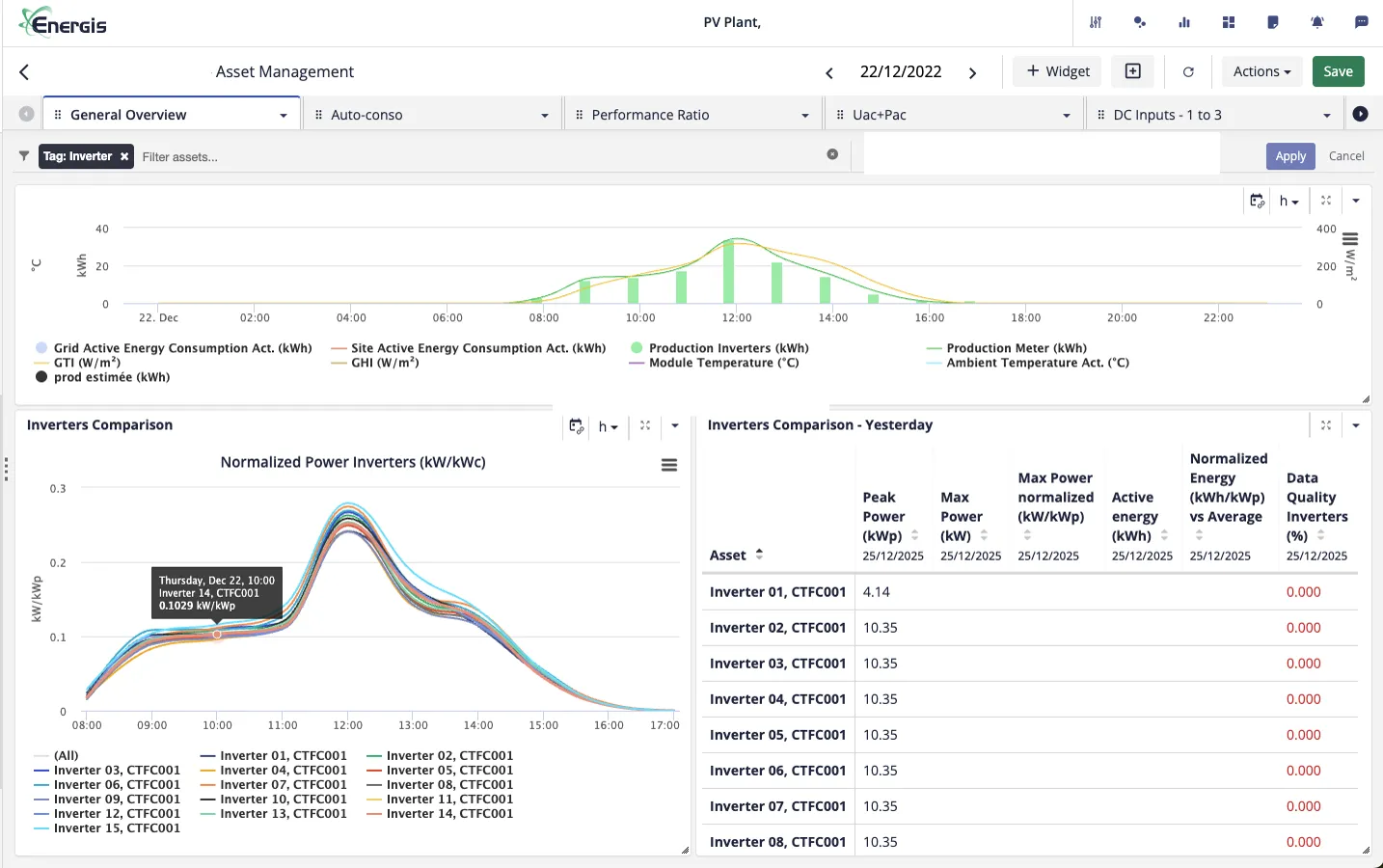 The general overview of a PV plant over one day: production against irradiance and module temperature, the normalised power (kW/kWc) of each inverter, and a table comparing their peak power, energy, specific yield and data quality.
Proactive problem solving
This granular data leads directly to proactive problem solving. Consider the common issue of panel soiling. A basic system might only show a slight drop in overall plant output. In contrast, with specific yield per inverter and a rule that compares each inverter with its own past (for example, kWh/kWp this week against four weeks ago), Energis.Cloud can flag the inverter whose output has drifted. This allows maintenance teams to address localised issues like dust accumulation. Literature shows these issues can cause power losses of up to 15.5%. By intervening early, teams recover lost production and prevent long-term thermal stress.
Financial revenue assurance and automated transparency
For asset owners, the ultimate measure of success is financial return. A primary challenge is accurately bridging the gap between technical KPIs and bottom-line results. Technical metrics alone are insufficient. Therefore, they must be clearly linked to revenue to inform strategic business decisions.
Streamlining financial workflows
Energis.Cloud automates financial asset management. It directly addresses core responsibilities like revenue control and stakeholder reporting. The platform provides tools designed to ensure accuracy and reduce administrative burden:
- Scheduled financial reports: reports detailing the performance of individual assets or entire portfolios, sent on your cadence.
- Turnover follow-up: actual turnover compared with the estimated turnover, month by month, for cash flow management.
- Tariffs as formulas: revenue calculated with the tariff you write as a formula or take from a lookup of rates, such as a feed-in tariff or a Power Purchase Agreement (PPA) price.
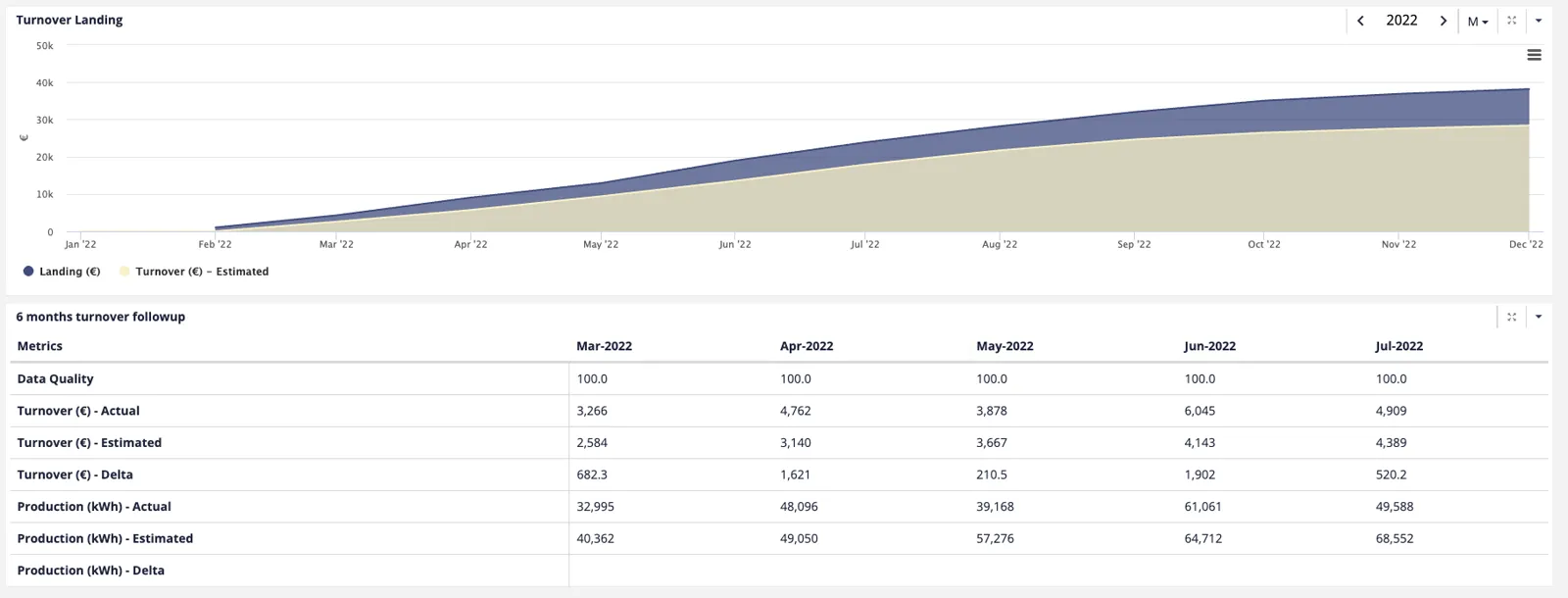 Revenue follow-up of a PV plant: cumulative actual turnover against the estimate over the year, and a six-month table of data quality, turnover and production, actual against estimated.
Validating bankability
Ultimately, the platform’s rigorous data handling provides a credible framework for performance verification. This gives lenders and investors the confidence needed to validate revenue reports. A subtle 1% Performance Ratio decline is no longer an abstract metric: in Energis.Cloud, it shows as a turnover gap against the estimate. This direct link gives all stakeholders a clear view of their ROI.
Operational excellence through anomaly detection
The greatest threat to profitability is “invisible revenue loss”: periods of underperformance that go unnoticed for long durations. Operational excellence depends on minimising the time between an event and corrective action. Consequently, an effective platform must detect anomalies and report each one specifically.
Diagnostic precision
In Energis.Cloud, you write anomaly rules for the failures that cost production. These are not generic alarms: each one names the problem it checks.
| Anomaly | Problem detected | Strategic value |
|---|---|---|
| Inverter/string outage | An inverter or other key component has shut down, ceasing energy production. | Flags a complete or partial production stoppage, enabling rapid dispatch of maintenance teams to minimise generation loss. |
| Meter vs. inverter mismatch | The sum of energy produced by the inverters does not match the energy recorded by the main export meter. | Catches potential meter failures and data misconfigurations before they lead to significant, incorrect billing cycles or revenue disputes. |
| Site communication loss | The platform is no longer receiving fresh data from a site’s data logger or communication gateway. | Prevents operational “blind spots” by identifying data gaps, ensuring that performance analysis and reporting remain accurate and complete. |
Measurable impact on MTTR
Specific findings help reduce the mean time to repair (MTTR): maintenance teams arrive on site already knowing which inverter or which data stream failed. In addition, this systematic prevention ensures that silent failures do not erode profitability over time.
Conclusion: the integrated future
In today’s competitive energy market, a new standard for solar asset management has emerged. It is no longer sufficient to simply collect data. Instead, owners must turn data into information that drives financial performance. Energis.Cloud goes beyond traditional monitoring, with one view of the technical and the financial performance of the portfolio.
For large portfolios, this integrated approach is a strategic imperative. It provides a unified framework for managing both energy and economic performance. Ultimately, an integrated platform gives owners the information they need to protect their ROI and long-term profitability.
Frequently Asked Questions
My portfolio contains disparate hardware from multiple manufacturers. Can Energis.Cloud centralise this data?
Yes. Energis.Cloud acts as a unified hub: inverters, data loggers and grid operators are among its 121 data-source connectors, which removes data silos and provides a single source of truth.
How does Energis.Cloud differ from standard PV monitoring software?
Standard monitoring often just visualises past data. Energis.Cloud supports asset management with inverter-level monitoring and specific yield, financial follow-up against estimates, scheduled reports and anomaly rules for the failures that cost production.
How does the platform help reduce “invisible revenue loss”?
By using specific anomaly rules rather than generic alarms. Rules like “Meter vs. Inverter Production Mismatch” or “Data Frozen” name the problem, allowing O&M teams to fix issues faster and minimise costly downtime.
Can the platform handle financial structures like PPAs?
Yes, where the tariff can be written as a formula or a rate lookup. Revenue is then calculated from the kilowatt-hours of each plant and reported to investors and stakeholders on a schedule.
New articles and product updates by email
Guides, customer stories and what is new in Energis.Cloud. You can unsubscribe at any time.
We use your email address only to send these updates. See our privacy policy.