

Data integration
Every data source in one central hub
Check whether the meters, grid operators, inverters and building systems you use are already connected. The rest reaches Energis.Cloud through open routes (HTTP, MQTT, SFTP, email or a file upload), or through a connector we build with you.
A connector links one type of system. A data source is one connected device or feed. A data point is one series of readings, for example the electricity use of one meter. Read from every customer's platform.
Connectors
Is your system already connected?
Search for the brand or system you use, or pick a family. Each connector has its own page.
- Fudura
- Meterbeheer
- Enedis
- Enometrik
- Innax
- Engie
- Fluvius
- Joulz
- EnBW
- Kenter
- GRDF
- Datadis
- ARERA
- Groendus
- Brabant Water
- Anexo
- Eneco
- Ores
- E.ON
- Sibelga
- Resa
- Ealyze
- EDF Luminus
- Eveler
- Soregies
- VodafoneZiggo
- Weatherbit.io
- MQTT
- NUS Consulting Group
- HTTP push
- Ewon (HMS Networks)
- InfluxDB
- Elvaco
- Idetron
- MyThings (BehrTech)
- Eficia
- Adeunis
- Netmore
- Flukso
- Smartvatten
- Montreal Solutions
- Conclima
- EcoAdapt
- Schneider Electric
- Milieu Services Nederlands
- Kerlink
- Tyness
- Eastron
- Orange Live Objects
- WiSensys
- Enless Wireless
- 2Wire-LoWi
- Nanogrid
- Synaptiq
- Obix
- Smappee
- Sigfox
- Envitron
- Milesight
- Objenious
- Airzone
- Elsys
- Enginko
- Huawei Smartlogger
- SPIE
- 4-noks
- Accuenergy
- Advantech
- Danfoss
- Efento
- eGauge
- Elgas
- Enerray
- Enertronica Santerno
- Engie Laborelec
- Eniscope
- Fludia
- Fronius
- Gantner Instruments
- GreenWatch
- Honeywell
- Huawei
- IME
- Iskraemeco
- ITalks
- Johnson Controls
- Kamstrup
- Lovato Electric
- Maxee
- Meteocontrol
- Monnit
- Multiconnect
- Nemeus
- Nke Watteco
- Node-RED
- Phoenix Contact
- Power-One (Fimer)
- Priva
- Renu Electronics
- Resenergie
- Sauter
- Seneca
- Sensing Labs
- Siemens
- Skytron
- SMA
- Socomec
- SoDa
- Solar-Log
- SolarMax
- Soluzione Solare
- Sungrow
- Technolog
- ThingsLog
- Thytronic
- Tridium
- Wattsense
- Wattwatchers
- Webdyn
- Weidmuller
- Xantrex














































No source with that name yet.
See the line below: most systems still connect without development.
What your data becomes
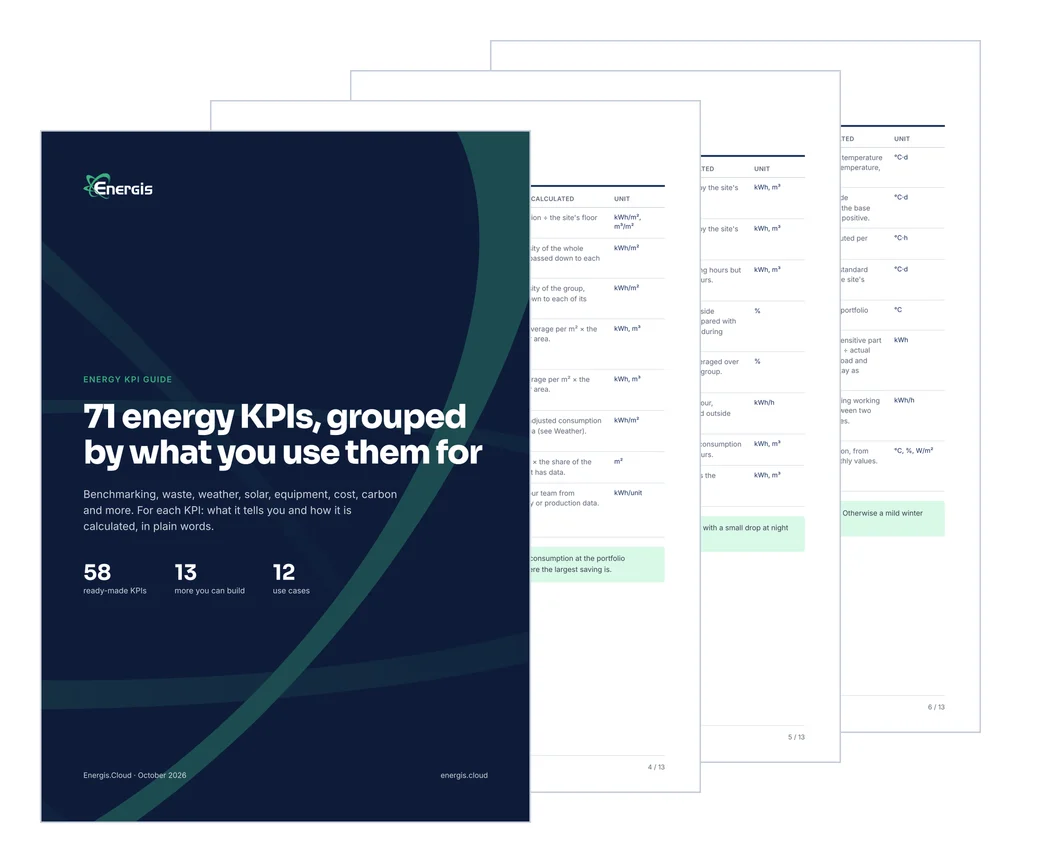
The energy KPI guide: from readings to the KPIs you report
Every reading feeds the metrics and KPIs behind your dashboards, reports and anomaly rules: intensities, cost, degree days, self-consumption. The guide lists them by use case, with what each one is calculated from.
We send you the PDF by email. We may contact you about Energis.Cloud; you can unsubscribe at any time.
Sites without data: field devices
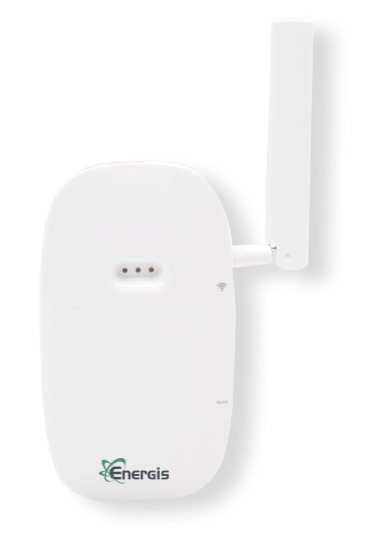
Having no data infrastructure on site is not a blocker. Energis.Cloud's field devices collect consumption, production and comfort data over LoRaWAN, and control HVAC and lighting remotely.
- Electricity
- Gas
- Water
- CO₂
- Temperature
- Lighting
- HVAC control
- Remote on/off
Data migration and integration
Whether you are switching systems or synchronising with existing software, Energis.Cloud handles the process with you.
Migration services
Moving away from outdated or inflexible software: our migration specialists handle everything, from data extraction to validation, and plan the transition so your history arrives complete.
Integration options
Already running a data lake or a third-party EMS: Energis.Cloud connects through the API to share and synchronise energy data, keeping your ecosystem unified.
Customers on bringing their data in
Before Energis, we had to import data manually in Excel sheets. Now all this is done automatically, which makes our life a lot easier.
Roel FloréProject Manager, Equans - Metiz
It is very reliable and with many useful data connectors. The support team always responds very fast!
Geert BellensEnergy Engineer and Co-owner, Metiz
Questions from IT, procurement and data teams
Where is our data hosted, and how is it secured?
Energis.Cloud runs on servers in the European Union, in ISO 27001-compliant data centres.
Who owns the data, and can we take it out again?
You do. We store and process it for you. Scheduled data exports deliver your data as files while you work with us. How you take your data with you if you leave is agreed in your contract.
Can Energis.Cloud exchange data with our ERP, invoice verification or BI systems?
Yes, with the API integration add-on: a documented REST API, in both directions. You read every figure, from collected readings to aggregated and calculated metrics, send data in, and manage your portfolio, such as creating assets. Service providers already run it in production: their invoice-verification and internal systems send data to Energis.Cloud and read the results back.
We already run a data lake or our own platform. What does Energis.Cloud add?
You keep it. Energis.Cloud reads from it, or feeds it through the API integration add-on, and adds what sits on top: one asset structure, KPIs, data quality, anomaly detection, actions, reports and a portal per client.
Who keeps the data flowing when a provider changes its API or a meter stops sending?
We do. We follow changes in providers' APIs and work with the data providers when a feed breaks. On your side, a "no data" anomaly is raised when a source stops sending for longer than the delay you set, for example two hours. The availability of every meter is measured continuously.
Can our team correct bad data itself?
Yes. Gaps, spikes and impossible values are corrected by rules your team sets, every correction stays on record, and dashboards and reports use the corrected values. See Data quality.
Is a new country or a new data provider a new project?
Usually not. Grid operators and metering companies in Belgium, the Netherlands, France and other countries are already connected, so a new country is mostly configuration. A source we do not have yet becomes a new connector, built on request.
How do we migrate without disturbing our clients?
Our migration specialists extract and validate your history before the switch, so every site arrives with its past data. You can move part of your portfolio first, and the rest follows once it is proven.
Can we start with a limited first phase?
Yes. A first phase on a representative set of sites shows the data, the quality checks and the reports on your own portfolio before the full rollout.
Get started
Bring the sources you use today
In a demo we look at the sources you use today and how each one reaches Energis.Cloud.
- The meters, grid operators and building systems you use today
- How your history moves over before the switch
- Pay only for what your portfolio needs